BAOMAIN MDQ-100A Bridge Rectifier Wave Diode Module 1600V
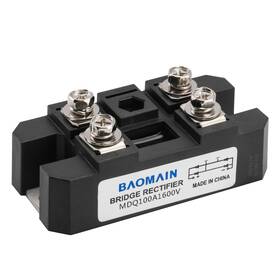
( Brand: Baomain ), ( Manufacturer Part Number: MDQ-100A ), ( Part Type: Bridge Rectifier Module ), ( Packageheight: 38 ), ( Packagelength: 109 ), ( Packageweight: 159 )
Review BAOMAIN Bridge Rectifier 100a 1600v Full Wave Diode Module One
The **BAOMAIN MDQ-100A Bridge Rectifier Module** is a high-performance, industrial-grade power conversion component designed to deliver robust and reliable full-wave rectification for demanding applications. Engineered with precision, this module features a **100-ampere current rating** and a **1600-volt reverse voltage capability**, making it ideal for heavy-duty electrical systems where efficiency and durability are critical. Constructed from high-quality **silicon diodes**, the MDQ-100A employs a **full-bridge configuration**, ensuring seamless AC-to-DC conversion with minimal voltage drop while maintaining exceptional heat dissipation. Its compact yet sturdy design allows for easy integration into power supplies, motor drives, inverters, and other high-current applications, where consistent performance under heavy loads is essential. The module s robust construction, featuring **metal housing and reinforced solder terminals**, enhances thermal conductivity and mechanical stability, reducing the risk of failure even in harsh operating environments. Whether used in industrial automation, renewable energy systems, or high-power electronic devices, the BAOMAIN MDQ-100A delivers uncompromising reliability, ensuring long-term operational efficiency with minimal maintenance requirements. Its compatibility with standard mounting solutions and straightforward wiring further simplifies installation, making it a versatile choice for engineers and technicians seeking a dependable rectification solution.
**Pros and Cons of buying a BaoMain MDQ-100A Bridge Rectifier (100A, 1600V Wave Diode Module)**
### **Pros**
1. **High Current and Voltage Rating** The 100A current and 1600V voltage rating make it suitable for heavy-duty applications, including industrial power supplies, motor drives, and high-power inverters. This ensures reliability in demanding environments where lower-rated rectifiers would fail.
2. **Wave Diode Module Design** The "wave" diode configuration (likely referring to a full-wave bridge with optimized current handling) improves efficiency by reducing voltage drop compared to standard diode arrangements, which can be beneficial in high-power applications.
3. **Compact and Modular Form Factor** Bridge rectifiers like this one are designed to be space-efficient, allowing for easier integration into existing power systems without requiring significant redesign.
4. **Potential for Cost-Effective High-Power Conversion** For applications requiring high current, using a dedicated bridge rectifier module can be more economical than assembling individual diodes, reducing soldering and assembly time.
5. **Compatibility with Common Power Circuits** It can be used in standard full-wave rectifier configurations, making it versatile for AC-to-DC conversion in power supplies, chargers, and motor controllers.
6. **Durability in Industrial Settings** High-quality materials and construction suggest it can withstand harsh conditions, including temperature fluctuations and transient voltage spikes, if properly heat-sinked.
---
### **Cons**
1. **Limited Availability of Detailed Specifications** Without a datasheet or clear technical documentation, there may be uncertainties about exact forward voltage drop, reverse leakage current, or thermal characteristics, which are critical for precise circuit design.
2. **Potential for Overkill in Smaller Applications** If the application only requires a fraction of its 100A rating (e.g., 10A 20A), the module may be unnecessarily large and expensive, leading to wasted power in heat dissipation.
3. **Heat Dissipation Requirements** A 100A rectifier will generate significant heat, requiring an adequate heatsink or cooling solution. Poor thermal management can reduce efficiency and lifespan.
4. **Cost** High-current, high-voltage modules like this are typically more expensive than lower-rated alternatives. The upfront cost may not justify the purchase for small-scale or low-power projects.
5. **Sourcing and Compatibility Risks** If the module is from a lesser-known brand (e.g., BaoMain), there may be concerns about long-term availability, quality control, or compatibility with other components in the circuit.
6. **Potential for Misapplication** Without proper understanding of the module s limitations (e.g., surge current handling, maximum junction temperature), it could be damaged if used in unsuited conditions.
---
### **Conclusion**
The **BaoMain MDQ-100A bridge rectifier** is a powerful and versatile component ideal for **high-power industrial applications** where reliability, current handling, and voltage tolerance are critical. Its strengths lie in its **high current/voltage ratings, efficiency, and modularity**, making it a strong choice for motor drives, large power supplies, or inverter circuits.
However, it may **not be cost-effective or practical** for smaller-scale projects due to its **high capacity, heat generation, and potential overkill**. Additionally, **lack of detailed specifications** and **brand reputation concerns** could be drawbacks for users requiring precise or long-term guaranteed performance.
### **Recommendation**
- **Buy if:**- You are working on a **high-power application** (e.g., industrial motor control, large inverter, or heavy-duty power supply) where 100A current is necessary.
- You have **adequate cooling** (heatsink or forced air) to handle the heat dissipation.
- You can **verify compatibility** with your circuit (e.g., input voltage, output requirements, and thermal management).
- You prefer a **pre-assembled module** over discrete diodes for ease of integration.
- **Avoid if:**- Your application requires **less than 30A 50A** of current, making a lower-rated rectifier more economical.
- You lack **detailed specifications** or **confidence in the manufacturer s quality**.
- You cannot ensure **proper thermal management**, risking premature failure.
- You are working on a **low-power or consumer-grade project** where cost efficiency is prioritized over raw capacity.
**Alternative Considerations:**- For **mid-range applications**, consider a **60A 80A rectifier** if 100A is unnecessary.
- If **efficiency is critical**, check for **Schottky diode-based modules** (though they typically have lower voltage ratings).
- **Verify reviews or datasheets** from trusted sources before purchasing to confirm real-world performance.
Ultimately, this module is best suited for **professional industrial use** where its high specifications are justified by the application s demands. For hobbyist or low-power projects, a more modest rectifier would likely be a better fit.
Details:
Repetitive Peak Reverse voltage : 1600V. Phase: Single Phase; Terminals: 4. Baomain Bridge Rectifier MDQ-100A, 100A 1600V, Full Wave Diode Module One Phase. Average Forward Rectified Current: 100A.
part #: mdq100a prices
- $22.18-$33.46
specifications powesupplipar:
- brand: Baomain
- mpn: Mdq-100a
- part type: Bridge Rectifier Module
- packageheight: 38
- packagelength: 109
- packageweight: 159
payments powesupplipar:
- credit card: Diners-club
- wallet: Paypal
- other
seller powesupplipar:
- # reviews: 2771
- rating: 98.8%
- city: Brooklyn, New York
offer powesupplipar:
- options: Ship-to-home
- quantity: 1
- started: April 23, 2026
- availability: In Stock
- sold: 0
general powesupplipar:
- Radio Communication > Parts Accessories > Power Supplies
- condition: New
returns powesupplipar:
- policy: No Returns
shipping powesupplipar:
- service: Standard
- class: Standard
- transit: 2-5 Days
- type: Fixed
- cost: $0.00
Baomain MDQ-100A Is Similar To:
- Baomain Mdq-300a Bridge Rectifier 300a 1600v Single Phase Ac To Dc Full (66.2% similar) High capacity 300A 1600V engineered for heavy-duty industrial performance, the MDQ-300A bridge rectifier supports a maximum average forward rectified current of and repetitive peak reverse voltage . Baomain bridge rectifier, MDQ-300A 300A 1600V single phase ac to dc full wave diode module, 4 ...(April 21st, 2026)